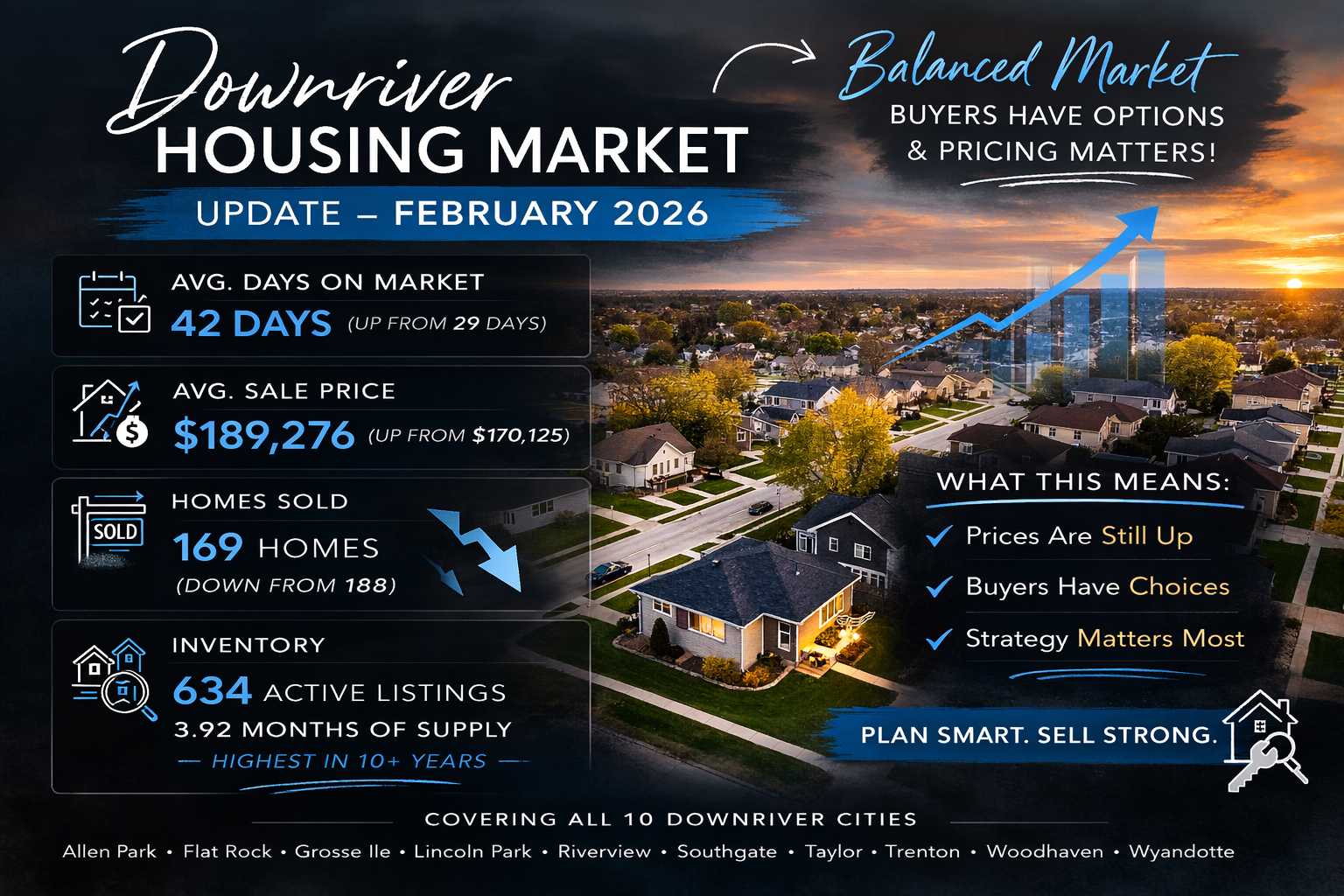
If you’ve been hearing that the Downriver housing market is “cooling,” “shifting,” or “normalizing,” the data confirms it — but not in the way many headlines suggest.
By comparing February 2026 to February 2025, we can see a market that hasn’t stopped, but has clearly changed pace. Here’s what’s happening and what it means if you’re thinking about selling.
Homes Are Taking Longer to Sell
-
Average Days on Market
-
February 2025: 29 days
-
February 2026: 42 days
-
Homes are spending more time on the market than they were a year ago. Buyers are no longer rushing into decisions; they’re touring more homes, comparing options, and taking time to evaluate value.
What this means:
Pricing and presentation matter more than they did in 2025. Homes that are priced accurately and show well are still selling — those that miss the mark tend to sit.
Prices Are Higher — But Growth Has Slowed
-
Average Sale Price
-
February 2025: $170,125
-
February 2026: $189,276
-
Values are higher year-over-year, which is good news for homeowners. However, the rapid appreciation of previous years has slowed, and buyers are more price-conscious.
What this means:
There is still equity in the market, but pricing based on “last year’s frenzy” can cost sellers time and negotiating leverage.
Fewer Sales, More Selective Buyers
-
Homes Sold
-
February 2025: 188
-
February 2026: 169
-
There were fewer closed sales this February compared to last year. This doesn’t signal a collapse — it reflects buyers being more selective and sellers needing stronger strategies to stand out.
What this means:
Demand hasn’t disappeared, but it’s concentrated on homes that align with what today’s buyers are looking for.
Inventory at a 10-Year High (By Supply)
-
Active Listings: 634 homes
-
Months of Inventory: 3.92 months
This is the most significant shift in the data.
Months of inventory measures how long it would take to sell all current listings at the current pace of sales. At 3.92 months, Downriver is experiencing the highest months of listing inventory in over a decade.
What this means:
Buyers have options. And when buyers have options, they compare more, negotiate more, and walk away more easily. This puts pressure on homes that are overpriced or underprepared.
Is This a Bad Market to Sell?
No — but it is a different market.
Today’s Downriver market rewards sellers who:
-
Price correctly from day one
-
Prepare their home to be move-in ready
-
Understand buyer behavior in their specific city
-
Work with an agent who has a clear local strategy
The days of “list it and it will sell itself” are behind us. Sellers who succeed now are the ones who plan.
Local Markets Matter More Than Ever
These statistics reflect the ten Downriver cities of:
Allen Park, Flat Rock, Grosse Ile, Lincoln Park, Riverview, Southgate, Taylor, Trenton, Woodhaven, and Wyandotte.
Each city behaves a little differently. What works in Taylor doesn’t always work in Trenton, and Wyandotte buyers don’t shop the same way as Woodhaven buyers.
In a more balanced market, local knowledge matters more than timing.
Final Thoughts
The Downriver housing market hasn’t stopped — it has matured.
And mature markets don’t punish sellers.
They reward preparation, realistic pricing, and strategy.
If you’re considering selling and want to understand how these trends apply to your home and your city, that’s where local insight makes the difference.